
Can Strength Training Prevent Injuries?
You're going to get injured at some point — the question is how badly, and how fast you bounce back. Research shows strength training can cut injury risk by up to two-thirds and turn a nine-month recovery into a two-week one. Here's how to get strong safely.
I got a reply to one of my emails recently that I haven't stopped thinking about. I'd been harping on consistency with strength training (as I do), and a client wrote back:
"And if you do tweak something, like I did last month, I'll take the two week recovery time over the 9 months it has taken me to recover in the past!"
That one sentence sums up something I want everyone to understand: strength training doesn't just help you avoid injuries. It changes what happens when you do get one.
Because here's the truth I hate to break to you — you are going to get injured at some point between now and the end of your life. A tweaked back moving a couch, a rolled ankle on a trail, a shoulder that flares up out of nowhere. The question isn't whether it happens. It's how often, how badly, and how fast you bounce back.
What the research says about injury prevention
People often tell me they're scared to lift weights because they might hurt themselves. I get it — it can feel intimidating the first time. But the research points the other way.
A large review of randomized controlled trials published in the British Journal of Sports Medicine found that strength training programs reduced sports injuries to less than a third compared to not training, and nearly halved overuse injuries. A follow-up analysis found the effect was dose-dependent — the more consistently people strength trained, the lower their injury risk dropped. Stretching alone, by the way, showed no meaningful protective effect.
Yes, there are injury risks with lifting weights. But there are far more injury risks to being weak.
This matters even more as you age. Better balance, coordination, leg strength, core and upper body strength are exactly what let you keep doing all the things you love — shovelling the driveway, playing with grandkids, hiking, curling, over-55 hockey tournaments — without the heightened risk of falling or hurting yourself along the way.
Why strong people recover faster
The part people talk about less is what my client experienced: two weeks of recovery instead of nine months. Strength training is also great for aiding recovery from injuries, and even from things like joint replacements. Here's why.
You start from a higher baseline. Active people begin an injury with stronger muscles and connective tissues, so they lose less strength and mobility during downtime — and regain it faster once rehab starts.
Better blood flow to healing tissues. Regular training improves capillary density and cardiovascular efficiency, meaning more oxygen and nutrients reach the tissues doing the repair work.
Denser bones. Strength training increases bone density, which helps you recover more efficiently after stress or injury and lowers your risk of fractures in the first place.
Better body awareness. People who train regularly have better coordination and movement patterns, so they relearn proper movement faster in rehab and avoid the compensations that drag recovery out for months.
That's the difference between an injury being a two-week annoyance and a nine-month setback.
How to strength train without hurting yourself
The goal is never to lift the heaviest weight in the room. The goal is to get as strong as you can in a way that makes you feel awesome and keeps you injury-free. A few principles I coach every day:
Start where you are, not where you think you should be. When I took up running years ago, I started with 13 minutes. Strength training is the same — start light, progress slowly, stay consistent.
Get your form coached, especially early. The basics — squats, deadlifts, push-ups, rows, presses — are safe and incredibly effective when someone teaches you to do them well.
Aim for 2-3 sessions a week. If you can make that a priority for the next three months, I know you will feel dramatically better than you do now.
This is exactly how we run things at Evolve. Our boot camps and women's-only strength classes build full-body strength with coaching on every rep, our Fitness Forever program is designed specifically for people 50+, and semi-private training is a great fit if you're coming back from an injury and want closer attention. You'll find us in Halifax (Strawberry Hill and downtown), Bedford, Dartmouth and Truro.
The best time to get strong is before you need it
Nutrition, sleep, stress — they're all part of the journey. But even if you're not ready to tackle those yet, strength training on its own will still drastically improve your life. I will remain persistent with this message because the impact is so real.
If you've been putting it off because you're worried about getting hurt, I hope this reframes it: the riskiest thing you can do for your body is stay weak.
Ready to start? You can try Evolve for 6 weeks for just $1 — every class, every location, real coaching the whole way. Grab your 6-week trial here.
And if you have questions about training around an old injury, just ask. I'm happy to help.
Matt
The Plate Method: How to Build a Balanced Meal Without Counting Calories
One of the most common questions I get as a coach is some version of: "I don't want to track calories — so how do I know if I'm eating right?"
Fair question. Tracking works great for some people, but it's not for everyone, and you definitely don't need an app to build a healthy, satisfying meal. You just need to look at your plate.
This is called the plate method, and it's one of the simplest, most sustainable nutrition tools I know. No math, no weighing chicken on a food scale, no guilt. Just a visual guide you can use at home, at a restaurant, or at your mother-in-law's Sunday dinner.
What Is the Plate Method?
Here's the basic version I give our clients:
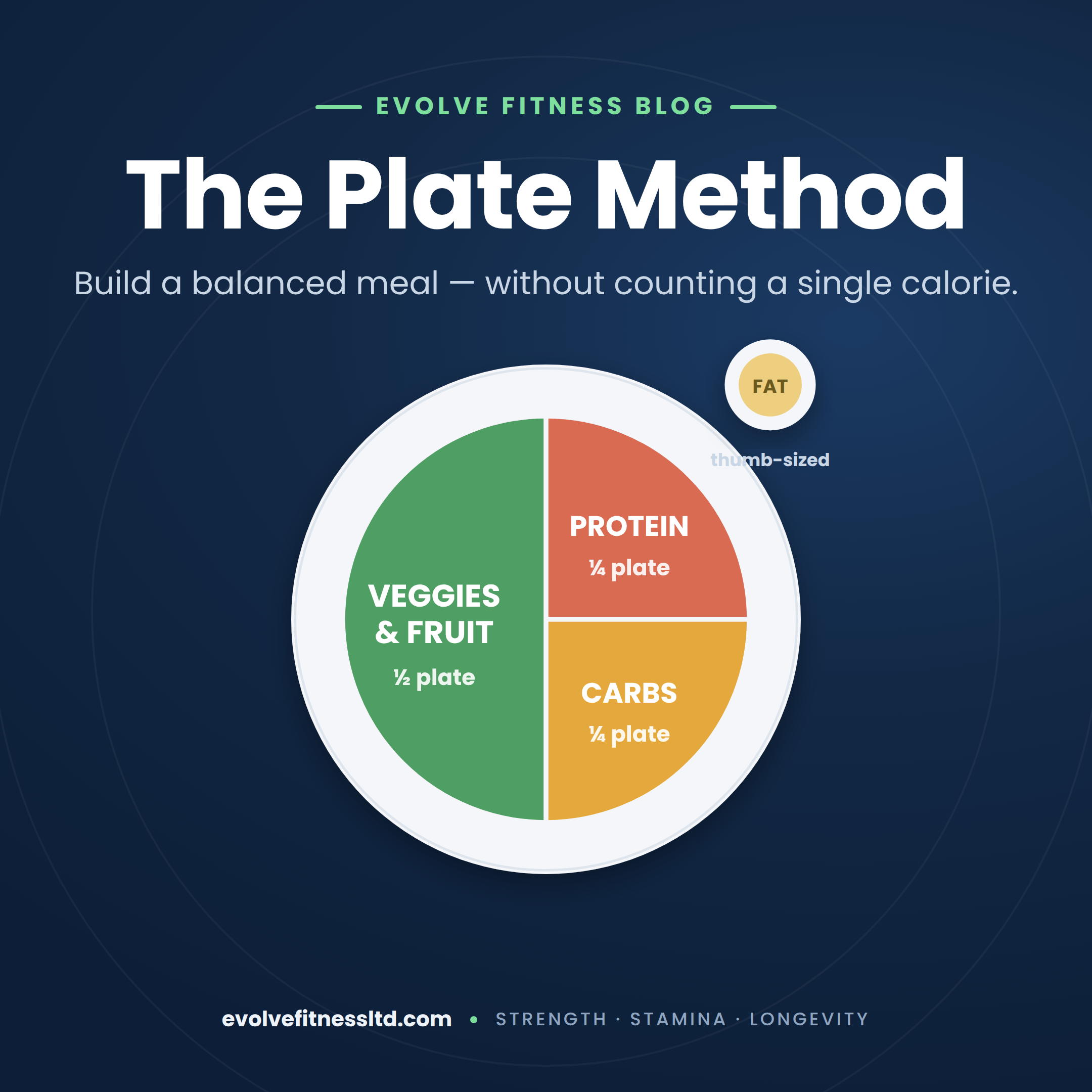
Half your plate: fruits and/or vegetables
One to two palm-sized portions: protein (chicken, fish, beef, eggs, tofu, beans)
One to two handfuls: carbs (potatoes, rice, pasta, bread, oats)
One thumb-sized portion: fat (butter, oil, dressing, nut butter)
If that looks familiar, it should — it lines up closely with Canada's Food Guide, which recommends filling half your plate with vegetables and fruits, a quarter with whole grains, and a quarter with protein foods. The science-backed guidance and the practical coaching advice land in the same place: build your meal around plants and protein, and the rest tends to take care of itself.
The beauty of using your own hands as the measuring tool is that they're always with you, and they're roughly scaled to your body. A bigger person has bigger hands and needs bigger portions. It's not lab-precise, but it doesn't need to be.
When the Hand Guide Doesn't Quite Work
Sometimes the palm-and-handful approach is hard to apply — maybe you're eating a mixed dish, or you want a little more structure. Here's the second version I use:
Half your plate fruits and/or veggies, or roughly 2-3 fist-sized portions
One medium-to-large piece of meat, or aim for 30+ grams of protein based on the label
Half to 1 cup of carbs
1 tablespoon of fat, or whatever one serving on the label is (usually 80-120 calories)
Either version works. Pick whichever one clicks for you and run with it.
Why the Plate Method Works So Well
A few reasons this simple picture punches way above its weight.
You'll actually feel full. Half a plate of veggies plus a solid portion of protein is the most filling combination there is. Fibre and protein are the two biggest drivers of satiety, so meals built this way keep you satisfied for hours instead of hunting through the pantry at 9pm.
Portion control happens automatically. You're not banning any food. Carbs and fats are on the plate — they're just in portions that match your goals instead of taking over the whole thing.
It travels. You can eyeball a plate anywhere. Restaurant, buffet, holiday dinner, food court. No app required, no awkward weighing of your meal in front of friends.
It builds the habit that matters. Whether your goal is fat loss, more energy, or just eating better as you age, the foundation is the same: mostly whole foods, plenty of plants, enough protein. The plate method bakes all of that in without you having to think about it.
What About Snacks?
Honest answer: the plate method is hard to apply to snacks. It's really a tool for full meals. For snacks, I like to keep it simple — try to pair a protein with a fruit or veggie. An apple with a cheese string. Greek yogurt with berries. Veggies and hummus. Same principles, smaller scale.
Putting It Into Practice This Week
Don't overhaul everything at once. Pick one meal a day — supper is usually the easiest — and build it using the plate method. Do that for a couple of weeks and it becomes automatic, then let it spread to your other meals.
Stuck for ideas? You can even ask an AI tool to build you recipes: tell it the foods you like and ask it to follow the plate guidelines above. Boom — a week of balanced meals at your fingertips.
And if you want real humans in your corner, this is exactly the kind of thing we coach every day at Evolve Fitness. Between our boot camps, women's-only strength, and free fat loss coaching across our Halifax, Bedford, Dartmouth, and Truro locations, we'll help you match your nutrition to your training so the results actually stick.
Ready to Get Started?
If you've been waiting for a sign to get going on your health, this is it. Try Evolve Fitness with our 6-week trial for just $1 — unlimited classes, real coaching, and a community that has your back.
Claim your 6-week $1 trial here.
Strength. Stamina. Longevity.
Matt
How to Improve Your VO2 Max (and Why It Matters as You Age)
A large study out of the Cleveland Clinic followed over 120,000 patients and found that cardiorespiratory fitness was one of the strongest predictors of longevity they measured — stronger than many of the classic risk factors we all worry about.
Lately I've been having more conversations than ever with friends in their 50s, 60s and 70s about working out. And I absolutely love it.
One topic that keeps coming up is VO2 max. It sounds like something only marathon runners should care about, but it might be the single most important fitness number for how long — and how well — you're going to live.
So let's break it down: what VO2 max actually is, why it matters so much, how to measure yours, and the many ways to improve it (no marathon required).
What Is VO2 Max?
VO2 max is the maximum amount of oxygen your body can take in and use during exercise. Think of it as the size of your engine. The bigger the engine, the more you can do — climb stairs without gasping, keep up with the grandkids, say yes to the hike, carry the groceries in one trip.
It naturally declines as we age, which is exactly why it's worth paying attention to. The good news? It responds to training at any age.
Why VO2 Max Matters So Much
Here's the part I find genuinely motivating.
A large study out of the Cleveland Clinic followed over 120,000 patients and found that cardiorespiratory fitness was one of the strongest predictors of longevity they measured — stronger than many of the classic risk factors we all worry about.
And the biggest gains go to the people starting from the bottom. Simply bringing your VO2 max from "low" (the bottom 25th percentile) up to "below average" is associated with roughly a 50% reduction in all-cause mortality. Go from "low" to "above average" and the risk reduction is closer to 70%.
All-cause mortality means dying from any cause. Those are enormous numbers.
Do you need to become a marathon runner to get these results? Absolutely not. You just need to get moving in some capacity, with a plan that helps you progress from where you are now to a higher level over time.
How to Measure Your VO2 Max
You don't need a lab to get a solid estimate.
The 12-minute run test. Find a flat surface, run (or run/walk) as far as you can in 12 minutes, and plug your distance into an online Cooper test calculator. It'll estimate your VO2 max.
The 1-mile walk test. If running isn't your thing, walk one flat mile as quickly as you can, take your heart rate when you finish, and enter your numbers into a Rockport walk test calculator.
A fitness watch. Devices like Garmin will estimate it too. A tip from my own experience: my 12-minute run test came out 5+ points higher than my Garmin number, so treat the watch as a trend tracker rather than gospel.
Lab testing. For truly accurate numbers, a max-effort test with a metabolic analyzer is the gold standard. We offer VO2 max testing at Evolve Integrated Health on a treadmill or spin bike for anyone who wants real data.
One important note: if you aren't currently doing any cardio, don't jump straight into an all-out test. Check with your do first and build a base before you push hard.
Activities That Improve VO2 Max
This is my favourite part, because the list is so much longer than people think: walking, running, rowing, biking or spin class, swimming, aerobics and dance classes (yes, Zumba counts), strength training done in circuits or HIIT style, sports, martial arts — really any activity where you get your heart rate up for extended periods. Even a physical job counts.
At Evolve, our spin classes, 30-minute cardio workouts and boot camps across Halifax, Bedford, Dartmouth and Truro are all built to do exactly this — and our Fitness Forever program does it at the right pace for the 50+ crowd.
Start Slow (Please)
Whatever you do, don't go from 0 to 60 this week.
When I took up running many years ago, I will never forget that I started with 13 minutes. That's it. Thirteen minutes, and then I built up slowly over time while doing everything I could to stay injury-free.
That's the model. Start where you are, progress gradually over weeks and months, and get professional guidance if you can. Consistency beats intensity every single time — and if you're just getting started, you're the person with the most to gain. Remember those mortality numbers: the biggest payoff goes to the folks moving from "low" to "below average."
Ready to Get Your Heart Rate Up?
If you want a plan, coaching and a community that makes cardio something you actually look forward to, come try us out. You can get 6 weeks at Evolve for just $1 — every class, every location, real coaches in your corner.
Start your 6-week $1 trial here.
Have a great day.
Matt
Does Lack Of Sleep Cause Weight Gain?
When our clients hone in on their sleep habits, it is always a game changer. I've seen it over and over: someone can be doing everything "right" with their workouts and nutrition, but if they're running on five or six hours of sleep, progress crawls.
So does lack of sleep actually cause weight gain? Not directly — a bad night's sleep doesn't magically add fat to your body. But sleep deprivation stacks the deck against you in ways that make fat loss much, much harder. Let me walk you through what's really going on.
What Sleep Deprivation Does to Your Appetite
Here are the basics of what happens when you're short on sleep:
When you are sleep deprived, you are awake more hours. More waking hours means more opportunities to eat, and that alone can quietly add meals and calories to your day.
When you are sleep deprived, ghrelin — the hormone that makes you feel hungry — goes up. At the same time, leptin — the hormone that tells your brain you're full — goes down. So you feel hungrier and less satisfied by the food you do eat. That's a rough combination when you're trying to stay in a calorie deficit.
And when you are sleep deprived, your brain actively craves sugary, fatty, high-calorie foods. This isn't a willpower problem — research has shown that short sleep changes how the reward centres of your brain respond to food. In studies where people were restricted to just a few hours of sleep, they ate several hundred extra calories per day, mostly from snacks, without even trying to.
Put all of that together and you can see why "I'll just push through on less sleep" tends to backfire.
Sleep and Your Workouts
The appetite side is only half the story. When you are sleep deprived, you won't recover as well from your workouts. You'll notice more soreness, less energy in your sessions, and slower strength gains.
There's an even bigger reason to care if fat loss is your goal. In a well-known University of Chicago study, dieters who slept 8.5 hours a night lost mostly fat. When the same people dieted on 5.5 hours of sleep, they lost the same amount of weight — but far more of it came from muscle instead of fat. Same diet, same scale result, very different body composition.
And keeping your muscle is exactly what we're after. Muscle is what keeps your metabolism humming, protects your joints, and keeps you strong for everything life throws at you.
The 3 Habits That Fixed My Sleep
Now, you are not me and you must find what works for you. But here are the three things that genuinely fixed my sleep, in order of impact:
1. No screens 30+ minutes before bed. A run-off of this one: no news and no social media before bed either, which is just as important. Winding your brain down matters as much as dimming the light.
2. No phone in the bedroom. This one is twofold. I can't look at my phone in the middle of the night, and I have to physically get up to turn off my alarm in the morning — so no snooze button, no drifting back to sleep.
3. Just go to bed on time. For me, this meant giving up watching late-night sports (unless it's the playoffs). For many of you it might be Netflix or "one more episode." Whatever your version is, it's probably the thing standing between you and an extra hour of sleep.
I'll be honest — there's more I could be doing. I don't have blackout curtains, and I can't seem to get on board with a cool bedroom. You don't need to be perfect. Pick the one or two changes that would move the needle most for you and start there.
Control What You Can
I know many of you have things outside your control when it comes to sleep — young kids, shift work, a snoring partner, stress. If that's you, please don't read this as one more thing to feel guilty about.
But most of us also have things within our control that we just aren't doing. And if we did them, we'd feel a noticeable shift within a couple of weeks — in energy, in cravings, in how our workouts feel.
Sleep is one of the "big rocks" of health, right alongside exercise and nutrition. That's why our coaches across all our Nova Scotia locations — Halifax, Bedford, Dartmouth, and Truro — talk about sleep with clients just as much as we talk about squats, whether you're in boot camp, our 30-minute cardio classes, or our Fitness Forever program for the 50+ crowd.
Ready to Feel Better?
If you want help putting the whole picture together — training, nutrition, sleep, and everything in between — come try us out. You can get started with our 6-week trial for just $1 at any of our five locations. Grab your spot here.
Have a great day
Matt
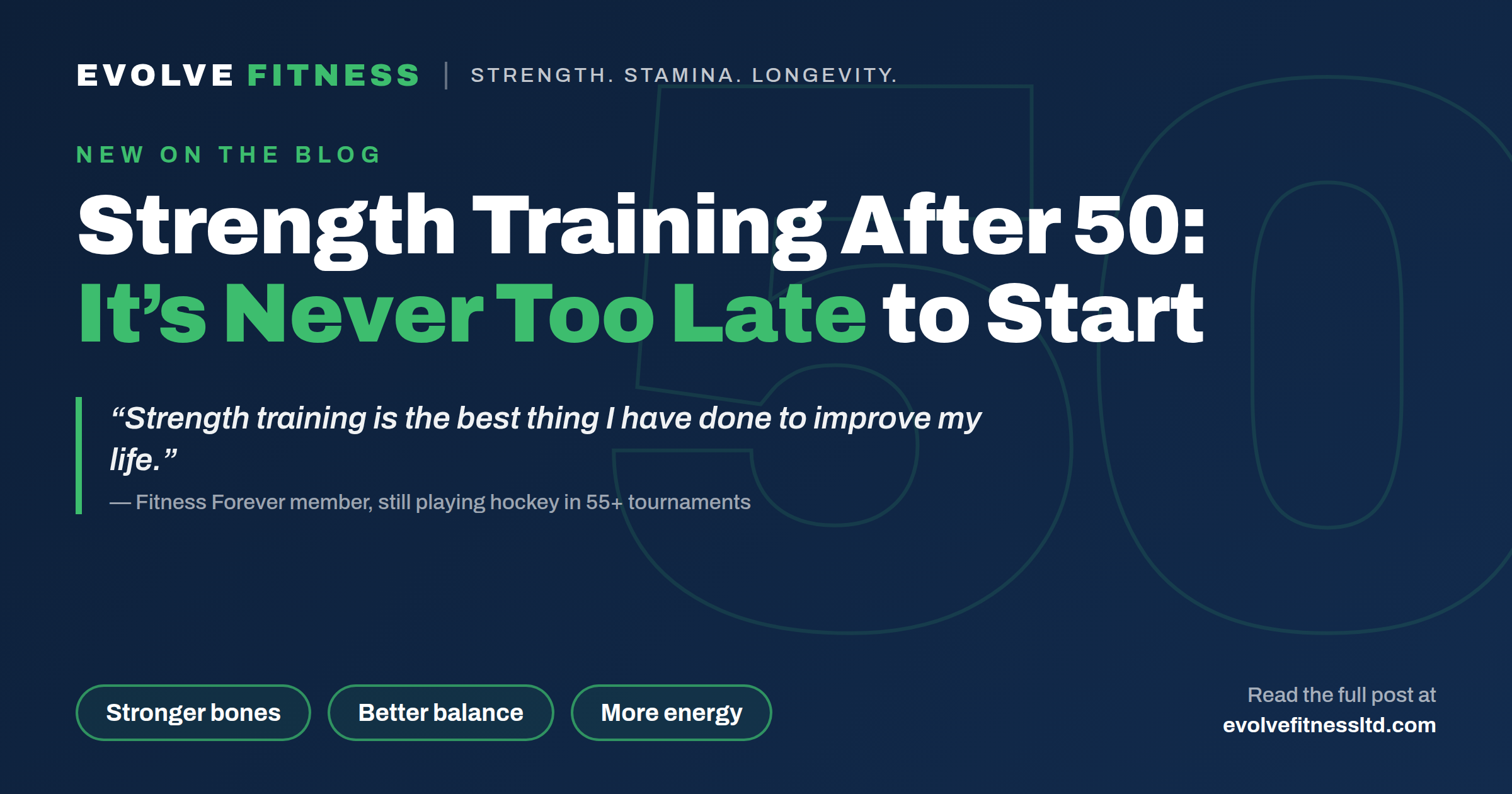
The Benefits of Strength Training After 50 (It's Never Too Late to Start)
Last week I got a simple, short, but impactful reply to one of my emails.
It just said: "Strength training is the best thing I have done to improve my life."
Last week I got a simple, short, but impactful reply to one of my emails.
It just said: "Strength training is the best thing I have done to improve my life."
That came from a great friend in our Fitness Forever program who is still playing hockey in over-55 tournaments. Not "still getting around okay." Still competing. Still doing the thing he loves.
I hear versions of that message all the time, and it's why I will stay persistent about this: strength training is life changing, and it's especially life changing after 50.
"Isn't Lifting Weights Risky at My Age?"
I get it. Strength training seems scary. It even seems risky for injuries.
I can tell you it is scary the first time. You get over that pretty quickly once you realize it's not what you've been picturing — nobody is asking you to load up a barbell and grunt through it on day one.
And yes, there are injury risks with any exercise.
But here's the part almost nobody says out loud: there are more injury risks to being weak.
After about age 30, adults naturally lose muscle mass every decade — and that loss speeds up after 60 if you do nothing about it. Researchers call it sarcopenia. In everyday terms, it's the reason stairs get harder, groceries get heavier, and a small stumble turns into a serious fall.
The good news? Strength training pushes back on all of it, at any age. Studies consistently show people in their 60s, 70s, and beyond building real, measurable strength within a few months of starting.
What Strength Training Actually Does for You After 50
The full list of benefits is long, but here are the ones that matter most for living well as you age:
Stronger bones. Resistance training increases bone density, lowering your risk of osteoporosis and fractures — especially important for postmenopausal women.
Better balance and fewer falls. Stronger legs, hips, and core mean better stability. Falls are one of the biggest threats to independence as we age, and strength training is one of the best defences we have.
More muscle, better metabolism. Muscle burns more calories at rest and helps your body manage blood sugar. Resistance training improves insulin sensitivity, which matters for anyone with — or at risk of — type 2 diabetes
Easier everyday life. Lifting, bending, carrying, getting off the floor, keeping up with grandkids. Strength is what makes all of it feel easy instead of exhausting.
A healthier heart and mind. Regular resistance training supports healthy blood pressure and cholesterol, and it's linked to better sleep, lower stress, reduced symptoms of depression, and more confidence.
A longer, fuller life. Research keeps finding that people who maintain muscle and strength live longer and stay independent longer.
Here's the other thing. Nutrition, sleep, stress — those are all part of the journey. But even if you aren't able or ready to change those things yet, strength training on its own will still drastically improve your life.
How to Start (Without Going 0 to 60)
You don't need to figure this out alone, and you definitely shouldn't jump straight into the heaviest thing you can find. Here's the challenge I give people depending on where they're at:
If you're already exercising regularly, stay consistent and see if you can gradually lift a little heavier. Get some guidance from your coaches on this.
If you're dabbling in and out, make strength training a priority 2 to 3 times a week for the next 3 months. That's also right in line with what public health guidelines recommend. If you can do that, I know you'll feel far better than you do now.
If you're brand new and nervous, start with support. This is exactly why we run our Fitness Forever classes for the 50+ crowd at our locations across Halifax, Bedford, Dartmouth, and Truro — along with boot camps, women's-only strength, and semi-private training if you want more individual attention. Every workout is coached, so you learn to move well and build up at your own pace, injury-free.
It's Never Too Late
My friend playing hockey in his over-55 tournaments didn't get there by accident. He got there with consistent strength training, week after week, year after year.
Your starting point doesn't matter. Your consistency from today forward does.
If you're over 50 and ready to see what strength training can do for you, come try Evolve with our 30 day Fitness Forever Trial. Details here.
Strength. Stamina. Longevity.
Matt
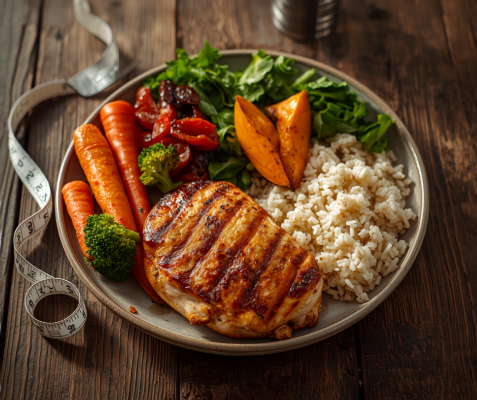
Is 1200 Calories a Day Enough to Lose Weight?
But for some reason, one idea refuses to die: that 1200 calories a day is the number for fat loss.
For most people, it's not just wrong — it can be dangerous. Let me explain.
Can I scare you into eating more calories today?
I know how hard it is to figure this stuff out. Between Google and social media alone, you're going to find conflicting views on pretty much every nutrition topic there is. But for some reason, one idea refuses to die: that 1200 calories a day is the number for fat loss.
For most people, it's not just wrong — it can be dangerous. Let me explain.
Where Did the 1200-Calorie Number Come From?
The 1200-calorie figure has been floating around diet culture for decades — it shows up in old magazine meal plans, generic diet programs, and even some calorie-tracking apps that default to it. It stuck because it's a nice round number that produces fast results on the scale.
But here's the problem: it was never based on your body. It's a one-size-fits-all number in a world where nobody is one size.
Your Calorie Needs Are Personal
Every single person reading this has different requirements to make progress, and lots of factors affect those requirements. One of the biggest — and the simplest to explain — is your current bodyweight.
The more you weigh, the more calories your body needs just to run your day-to-day life. Someone who weighs 120 pounds needs far fewer calories than someone who weighs 250 pounds. The 250-pound person may need double.
You'd have to live in a lab to know your exact numbers, but here are the general rules of thumb I use with clients:
10–12x your current bodyweight in calories per day for fat loss
12–14x your bodyweight for maintenance
14x and up for weight gain
This is a starting point. From there you adjust based on your activity level and your actual progress.
So if you weigh 120 pounds, 1200 calories might genuinely be in your range — and yes, it's hard being a naturally smaller person, because your requirements are just lower. But if you weigh 250 pounds, you're likely looking at 2500+ calories per day for fat loss. Eating 1200 would mean cutting your intake roughly in half of what your body needs — and your body will fight back.
What Happens When You Eat Too Few Calories
If you ate 500 calories today, nothing terrible would happen other than feeling hungry. The real damage comes from eating too little for an extended period of time. Here's what starts to happen:
1. Nutrient shortfalls. It becomes nearly impossible to get adequate vitamins, minerals, and macronutrients (protein, fats, carbs) on very low calories. Over time that can lead to a whole host of health problems.
2. Muscle loss. Without enough energy coming in, your body turns to your muscle for fuel and breaks it down. Since muscle is exactly what keeps you strong, mobile, and burning calories, this is the opposite of what you want.
3. Fatigue and weakness. You'll feel tired and drained — not just in your workouts, but in your whole life and your ability to get through daily tasks.
4. A weaker immune system. Chronic under-eating makes you more prone to getting sick.
5. A slower metabolism. Your body is incredibly good at adapting to its environment. If you chronically eat very low calories, it adjusts to run on less fuel — which is why the scale often stalls even though you're eating almost nothing.
6. Weaker bones. Long-term under-eating negatively impacts bone health, raising your risk of fractures and osteoporosis down the road.
The full list is longer, but that's as far as I feel qualified to go. If you recognize any of these in yourself, please chat with a professional — a dietitian or your doctor. If you need a referral, reply anytime and I'll point you to great people.
What To Do Instead
Forget the magic number. Aim for a moderate deficit based on your bodyweight, keep your protein up, eat plenty of fruits and veggies, and strength train so the weight you lose is fat — not muscle.
That last part matters more than most people realize. It's a big reason our boot camps and women's-only strength classes across Halifax, Bedford, Dartmouth, and Truro are built around progressive strength training — because losing fat while keeping (or building) muscle is what actually changes how you look, feel, and move.
Sustainable beats fast. Every single time.
Ready to Do It the Right Way?
If you want a plan that fuels your body properly and gets you strong instead of just smaller, come try us out. You can get 6 weeks at Evolve Fitness for just $1 — coaching, classes, and a community that has your back.
Start your 6-week $1 trial here.
Have a great day.
Matt
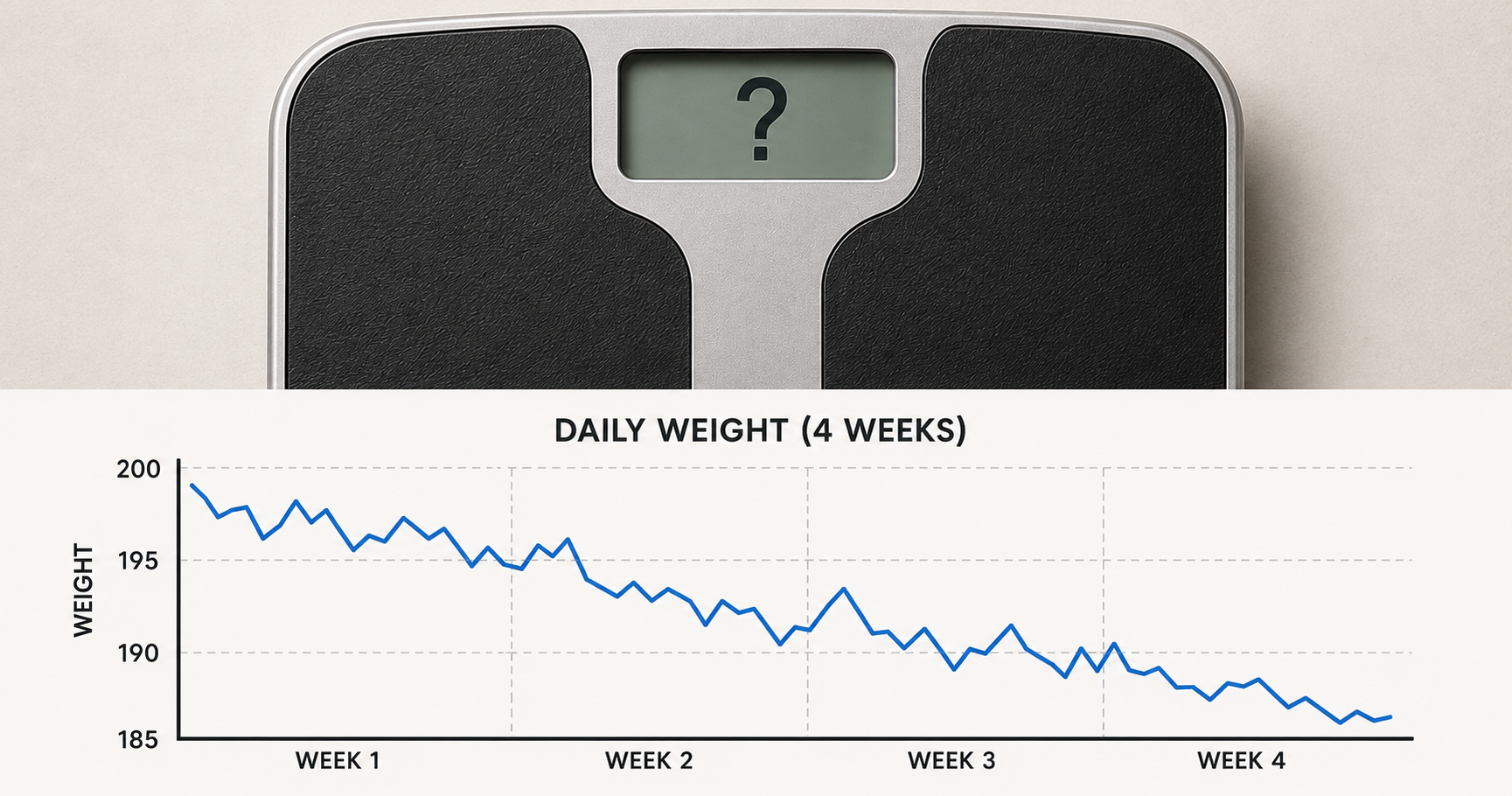
Why You Can’t Trust The Scale Week To Week
If you've ever stepped on the scale after a solid week of eating well and exercising, seen the number go UP, and wanted to throw the whole thing out the window — this post is for you.
If you've ever stepped on the scale after a solid week of eating well and exercising, seen the number go UP, and wanted to throw the whole thing out the window — this post is for you.
I want to share a real story from one of our fat loss coaching clients, because it shows exactly why judging your progress by weekly weigh-ins is one of the biggest mistakes I see.
A True Story: She Ate More and Lost More
One week, this client averaged 1,784 calories per day. She did her weigh-in and had gained 1.4 pounds.
The very next week, her average was 1,925 calories per day — over 140 calories MORE per day. She lost 1.8 pounds.
Read that again. She ate more and lost more.
If she had judged herself week to week, one of two things probably would have happened. She might have quit the program entirely, because "I gained weight eating 1,784 calories, so what's the point?" Or she might have slashed her calories even further trying to force the scale down — and then missed out on the weight loss that came the following week while eating MORE food.
Instead, she trusted the process. Her 4-week average came in at 1,781 calories per day, the weight is coming off, and it feels sustainable. On our coaching call she told me she's doing awesome — and she is.
That's winning.
Why the Scale Bounces Around So Much
Here's the thing: your body has no idea what week it is. Day to day, your weight can swing by 2 to 5 pounds (this same client sees up to 5 pounds of fluctuation), and almost none of that is body fat. Here's what's actually moving the number:
Water retention. This is the big one. Extra sodium, a hard workout (your muscles hold water while they repair), stress, and poor sleep can all cause your body to hang on to water for days at a time.
Carbohydrate storage. Your body stores carbs in your muscles as glycogen, and every gram of glycogen is stored with roughly 3 grams of water. Eat a higher-carb day and the scale jumps — but it's fuel and water, not fat.
Hormones. For women especially, weight can climb several pounds at certain points in the monthly cycle, then drop right back off.
What's simply in your system. A bigger meal, a saltier restaurant dinner, or being a little backed up can all show on the scale the next morning.
Notice that none of these things are body fat. Gaining a pound of actual fat requires roughly 3,500 extra calories above what you burn. If the scale is up 3 pounds overnight, you did not eat 10,500 surplus calories yesterday. It's water and food weight, and it will sort itself out.
The Fix: Look at the Long-Term Trend
To lose fat, you need to be in a calorie deficit — but that deficit is averaged over time, not judged day to day.
So here's what I coach instead:
Weigh in consistently, but judge in 4-week blocks. One weigh-in is a data point, not a verdict. Four weeks of data tells you the truth. If the trend is going down and you feel good, keep doing exactly what you're doing.
Expect up weeks. They're coming — after weekends, after vacations, after hard training weeks. An up week inside a downward trend is completely normal.
Track some non-scale measures too. How your clothes fit, your energy, your strength in the gym, photos. These often show progress when the scale is being stubborn.
Don't panic-cut your calories. Reacting to one bad weigh-in by slashing food is how people end up under-eating, feeling terrible, and quitting. Trust your averages.
This is exactly how we coach members through our free fat loss coaching, and it's the same mindset we build in classes like boot camp, women's-only strength, and Fitness Forever (50+) at our Evolve Fitness locations across Halifax, Bedford, Dartmouth, and Truro. The people who win are never the ones with perfect weeks — they're the ones who stick around long enough for the trend to do its thing.
The Bottom Line
The scale isn't lying to you on purpose — it's just measuring everything: water, food, glycogen, hormones, AND fat. Week to week, the noise drowns out the signal. Over months, the signal wins.
So stick with the plan. Zoom out. Judge yourself on the trend, not the Tuesday.
Ready to Stop Guessing?
If you want coaching, structure, and a community that keeps you consistent long enough to actually see results, come try us out. You can get 6 weeks at Evolve Fitness for just $1 — every class, every location, real coaching included.
Start your 6-week $1 trial here
Have a great day.
Matt

Are Cheat Days Good for Weight Loss?
I got a great question from a client recently: "How do I know when to have a cheat day, and how do I recover from it?"
Here's the good news. The whole idea of cheat days — and feeling like you need to "cheat" on your diet at all — has largely gone out the window.
I got a great question from a client recently: "How do I know when to have a cheat day, and how do I recover from it?"
Here's the good news. The whole idea of cheat days — and feeling like you need to "cheat" on your diet at all — has largely gone out the window. Ten-plus years ago it was all the rage, and like every fad, it came and went.
I used to do cheat days myself, until I learned how badly they were sabotaging my goals. These days, I enjoy my favourite higher-calorie foods in moderation, no matter what day of the week it is. Let me explain why that shift changed everything.
Where the Cheat Day Idea Came From
The old mindset went like this: deprive yourself of "treats" all week, then once a week (or two), eat all of your favourite foods in a single glorious day. That was your cheat day. Some people even promoted it as good for your metabolism — without any real evidence behind the claim.
The number one thing to remember is this: to reach your fat loss goals, you need to be in a calorie deficit. But that deficit is not a day-to-day thing. It's an average over time. Your body doesn't reset at midnight. It responds to what you do across weeks and months.
And that's exactly where cheat days fall apart.
What Cheat Days Were Actually Doing to Me
Two things kept happening when I did cheat days, and I see the same pattern in clients all the time.
First, my cheat days were really bad. If I'd bumped into a client at the grocery store on a Saturday morning, I would have been embarrassed by my cart. And the day was so high-calorie that it wiped out my entire week's deficit. One day of "cheating" undid six days of effort — my weekly average put me right back at maintenance, or worse.
Second, I felt like trash. My cheat day was always Saturday, so Saturday night, all of Sunday, and sometimes even Monday, I was zapped of energy and motivation. I was starting every week from behind.
Between the math and the misery, I was never really getting ahead. Sound familiar?
The Other Problems Nobody Talks About
Beyond my own experience, the cheat day mindset can bring some baggage that works against you long term:
An unhealthy relationship with food, where foods get labelled "good" and "bad." An emotional dependence on that one day of the week. A real risk of overeating that slides toward binge-style eating. And a plan that simply isn't sustainable — because white-knuckling deprivation for six days so you can "earn" the seventh is exhausting.
All food is energy, and you need energy to live. Some foods just carry more calories and fewer nutrients than others. That's it. There's no cheating involved in being a human who likes dessert.
What I Do Instead
When I finally understood that fat loss comes down to my average calories over time, everything changed for the better.
Now, if I want dessert, I have dessert. If I want a meal that's cheese whiz sandwiches (no judgment, please), I do that. No guilt, no "starting over Monday."
If I know a high-calorie stretch is coming — say, Thanksgiving weekend — I'll spend a few days beforehand eating a little lighter, with extra protein, fruits, and veggies. If it's an oopsie instead of a plan, I just do the same thing afterward. Either way, my average over time keeps me in a deficit, and I never feel deprived enough to "need" a blowout day.
That's the whole system. Enjoy the foods you love in moderation, keep the big picture in a deficit, and stay consistent — because consistency you can live with will always beat intensity you can't.
Building a Plan That Actually Fits Your Life
The goal is a nutrition plan that gets you the results you want and keeps you happy. That takes some time and some trial and error, and it works a whole lot better alongside regular training. That's exactly what we help people build every day at our Evolve Fitness locations across Halifax, Bedford, Dartmouth, and Truro — whether that's boot camp, spin, women's-only strength, or our Fitness Forever classes for the 50+ crowd. We also offer free fat loss coaching, so you never have to figure out the nutrition side alone.
I hope this helps reframe cheat days for you — and I hope we can retire the phrase "cheating on your diet" for good.
Ready to Ditch the All-or-Nothing Cycle?
If you want a plan (and a community) that makes consistency the easy part, come try us out. You can get 6 weeks at Evolve Fitness for just $1 — every class, every location, all levels welcome.
Get on the waiting list for our next 6 week trial here
Have a great day.
Matt
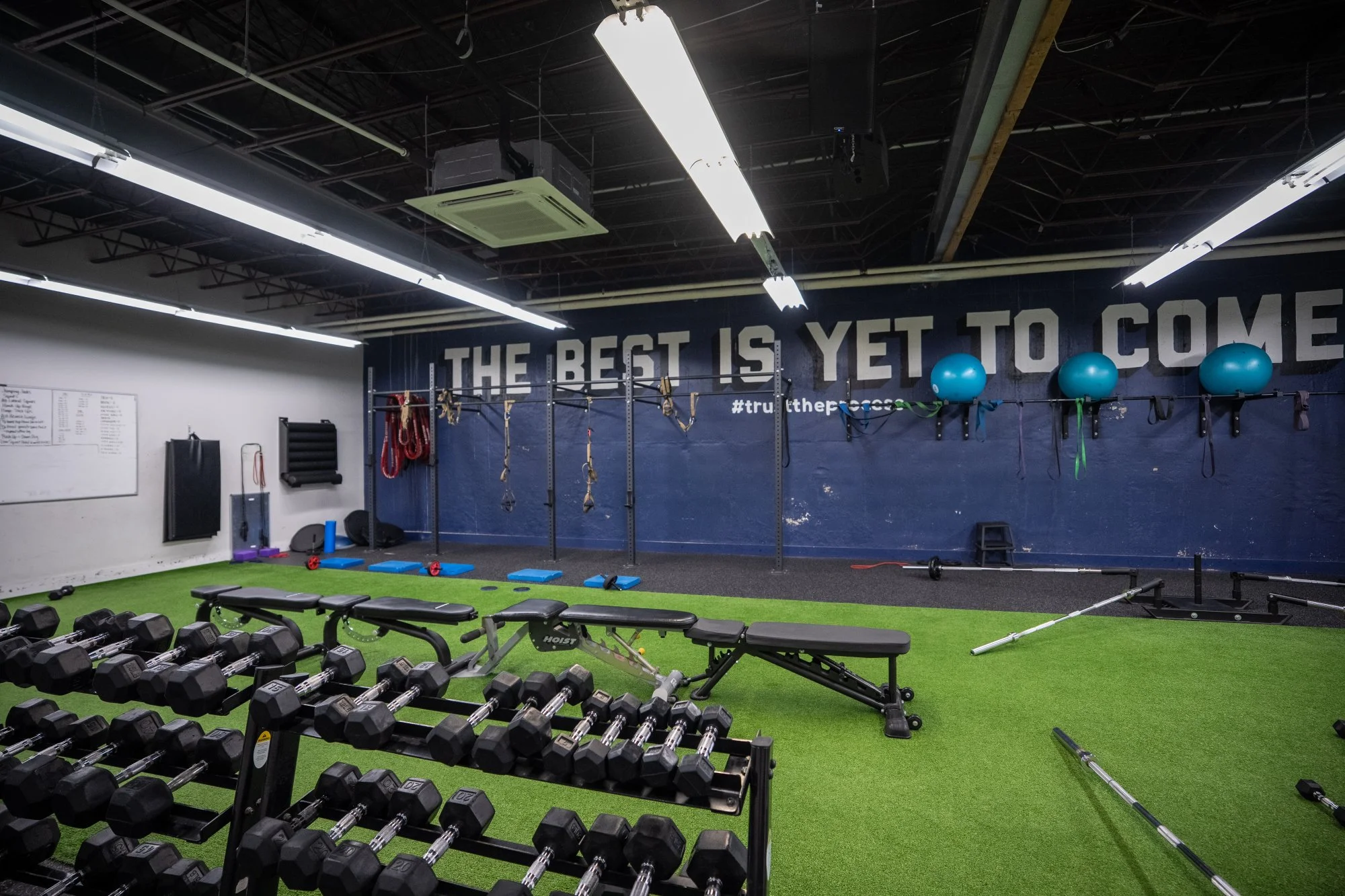
Boring=Winning
I want to tell you about the habit that kept me stuck for years. And on that is impacting many of you right now.
I was a program hopper.
Why You Keep Quitting Workout Programs (And the Boring Habit That Fixes It)
Quick answer: Most people quit a workout program around week two or three — not because the program stopped working, but because the excitement wore off. The fix isn't a new plan. It's picking one boring habit and repeating it long past the point it feels new. Consistency beats novelty every time.
The habit that kept me stuck for years
I want to tell you about the habit that kept me stuck for years — and the one that's quietly holding a lot of you back right now.
I was a program hopper.
Back in the bodybuilding.com days (I was pulling those up on dial-up in Hilden), I'd find a new program and get fired up. I'd write out every meal and every set and rep in my best handwriting. This was the one.
I'd do it for two weeks.
Then the excitement wore off. I'd quit, find a new program, and tell myself, "Okay, THIS is the one." Two weeks. Quit. Over and over.
Here's what finally clicked
The excitement ALWAYS wears off around week two or three. Every time. Not just for me — for everyone. And not just in fitness. In every "new" situation.
That's not a signal to switch programs. That's the exact moment that decides whether you get results or not.
The clients who win aren't doing anything shiny. We've had folks coming in for 17 years straight. They're probably sick of my face and Mitch's face by now. They show up anyway, curse us under their breath, and get shit done.
Why repetition is the whole point
It's the same with your training. If you want to get better at squats, you have to keep squatting. You can't do them once in June, again in September, and expect to improve.
That's why our workouts repeat the big lifts on purpose. It's not lazy programming — it's the stuff that actually makes you strong for real life.
Your one-step plan for this week
Pick ONE boring thing and just repeat it:
The same breakfast.
The same protein shake after your workout.
The same walk after dinner.
Boring isn't the problem. Boring is the strategy. Embrace it, and find other ways to get excited so you're not constantly hopping to the next new program.
Frequently asked questions
Why do I keep quitting workout programs after a couple of weeks? Because the novelty fades around week two or three — that's normal and happens to everyone. The drop in excitement feels like a sign the program is wrong, but it's actually the moment that separates people who get results from people who restart forever.
Is it bad to switch workout programs often? Yes, if you switch every few weeks. Constant program hopping means you never give any approach long enough to work. Most good programs need months of consistent repetition before the results show up.
How long should I stick with a program before changing it? Give a solid program at least 8–12 weeks of consistent effort before judging it. Real strength and fat-loss progress comes from repeating the same key lifts and habits over months, not from constant variety.
How do I stay consistent when I lose motivation? Don't rely on motivation — it always fades. Anchor one or two boring daily habits (same breakfast, same post-workout shake, same evening walk) so progress keeps happening even on the days you don't feel fired up.
Want help being consistent? Come be boring with us in the free Fat Loss Academy — or grab 5 massages for the price of 3 here to keep your body recovering while you put in the reps.
Written by Matt — coach at Evolve Fitness, helping people get real, lasting results for over 17 years.

Monday Motivation For Your Health Goals?
Discover how simple Monday habits—better sleep, fresh air—can supercharge your week and keep your wellness on track.
Happy Monday!
And we all know motivation Monday. I am actually a big believer in Monday and making sure it is a great day.
Why?
Because I personally have seen it both ways.
Scenario 1: You wake up Monday morning feeling refreshed after a great night of sleep. ⠀⠀⠀⠀⠀⠀⠀⠀⠀
Your workout clothes are laid out, you grab them and head off to your workout with a banana you left on the counter to easily grab.
After your workout, you eat your overnight oats already prepared and head off to work with your healthy lunch made the day before.⠀⠀⠀⠀⠀⠀⠀⠀⠀
After crushing a super productive day at work you come home to make dinner. You have everything ready after having planned your week of meals and getting the ingredients organized in advance.
You have a relaxing evening watching netflix and reading a book before heading to bed to do it all over again.
⠀⠀⠀⠀⠀⠀⠀⠀⠀
Scenario 2: You wake up frantically after hitting snooze 10 times because you stayed up too late on Sunday.
This means your workout will have to happen after work because you don't have time to do it in the morning now.⠀⠀⠀⠀⠀⠀⠀⠀⠀
You forgot to meal prep so you stop at the drive through to grab a muffin and a coffee to get you through the morning at work.
Lunch is takeout as well and then you hit the gym for a sluggish workout wishing you could take a nap instead.
Now you get home and eat supper while meal prepping for the rest of the week because you are behind and get to bed late again due to all of this.
Scenario 2 happened to be often in my early and mid twenties. And it still happens now and then. Usually because of drinks, food and late Saturday nights.
Scenario 1 happens most of the time and scenario 1.5 happens more than 1 (have some drinks and food Saturday but get on track Sunday).
But when I wake up rested on Monday morning and crush my workout and to do list, it's like I am on top of the world.
It sets the tone for the week and you are ahead of schedule rather than playing catch up.
Now a lot of people think they need motivation first.
When really they need action first because action leads to motivation, not the other way around.
So all you need to do on a Monday (or any day) is take a small action that will leads to some progress to your goals.
And then motivation is likely to follow!
And if you aren't sure what actions to take, just ask. That is what we are here for.
But just know that there is never going to be a perfect time. Today is as good of a day as any,
Have a great day
Matt
PS. If you want to learn more about Evolve in person or grab some free gifts, head to www.evolvefitnessltd.com

Fat Loss Non Scale Wins
Tired of fixating on the scale? Celebrate energy boosts, mental clarity, and better sleep as your true signposts to success.
Our next Fat Loss Academy challenge is coming up soon (details here) which means our latest challenge is finishing up.
We've had some incredible scale wins, but I asked the group to share success that had nothing to do with the scale. I am going to copy some of the responses below.
I love helping people lose weight because I know it is a challenge that is very hard to overcome.
But in reality, I am after everything else that you see below. I just know that when we start taking a look at our nutrition, exercise, sleep and stress for fat loss then all of the other magic happens.
One key takeaway I often see is feeling in control and having freedom around nutrition.
Let me know what your takeaways are I hope this gives you a little bit of inspiration to keep pushing with your health journey.
-------------------------
Honestly my mind shift is my biggest victory. I have been starting and quitting weight loss schemes most of my life.
For whatever reason this time is different. I got injured early on and am still trying to heal so my activity is limited but I haven’t used food as a crutch.
I’m enjoying feeling in control of the food and not feeling like the food is in control of me.
I have more energy, I’m sleeping better, my overall mindset is more positive. My clothes are feeling better and I feel like I’m doing something I can do forever.
-------------------------
SO many that are not related to weight loss. Mindset has shifted so much more than I thought, and not allowing road blocks such as a foot fracture, holidays and birthdays be the reason to say the heck with it (which was my normal pattern). Something has shifted and not sure why this time feels so much different than before. I don't feel deprived, good habits have formed and am so happy with all of the things that are happening. Energy is better, skin is better, mood is WAY better. My life has changed in that I am an active participant in my wellness and this journey is just starting :) SO very grateful for this community, not just for support but for accountability as well.
-------------------------
Inches lost, fitting into old clothes, fitting into jewelry, feeling better able to manage/incorporate special occasion foods/meals into my diet without sabotaging my progress, and less cravings. Much less emotional eating- and quick recognition of it when the desire strikes. My body feels fitter and stronger.
I don’t know when it happened, but my arms are starting to look better too! On Easter Sunday I went out in public in a sleeveless top for the first time in a very long time. This was a big deal for me
-------------------------
Oh there are too many to mention! The ones that are top of mind for me are:
1) climbing stairs with ease
2) lifting more weight
3) fitting into clothes that haven’t fit in a couple of years
4) a new social group
5) enjoying eating well again and being in control of my food
Like I said too many to mention… I am loving the classes and the Fat Loss Academy!!
-------------------------
At least half of the things listed above if not more. But above all, I feel in control of my wellness and my lifestyle choices and better at planning for myself and my kids not just in nutrition but all aspects. And my summer shorts fit! Wooo!
Chat soon!
Matt

Fitness Lies Online
Think you’ve heard it all on fat loss? Matt shatters the biggest myths and reveals the science-backed secrets to real results—no gimmicks.
Hey Ya’ll
I got triggered recently with some ads I saw on facebook about fitness and fat loss goals programs.
There are obviously many lies on the internet and the fitness lies are just as prevalent and just as dangerous.
Please be a good consumer and please be curious and ask questions when you see things that make you wonder.
Frustrating example.
All over the internet you see incredibly jacked and lean men and women doing some workouts. Cool.
Sometimes you will see them showing off their bodyweight workouts or their workouts where they are using light weights and doing burpees/jumping jacks/squat jumps and other cardio-ish full body moves.
Here's what they want you to think.
That these workouts are what made them look like that. Buy these workouts from them or these supplements.
Unfortunately this is a bullshit lie.
Marketing 101. Make it seem like it's easy and make it seem like it will happen quickly. IE. workout only 2-3x a week for 30 minutes just bodyweight, 21 day fix etc etc.
If you don't want more clients tell the truth. That it takes many years of dedication, effort and sacrifice to achieve transformational results.
Exactly 0 of the people doing those workouts got to where they are doing those workout. ZERO.
Here's what they have in common
-they might be blessed genetically
-they might be a former high level athlete who trained many hours a day for many years
-they definitely lifted heavy weights 3-4x a week for many years
-they definitely have been on very restrictive diets to get as lean as they are
-they may be on, or have been on, performance enhancing drugs
-it might be their job to look like that meaning they don't have any other commitments other than dedication to the lifestyle factors needed to look like that (ie. a job, kids, life etc)
So why are these people such scum?
Because they make you think that you can look like them by doing these garbage workouts.
And then they take your hard earned money when all you really want is to make progress to your goals.
This is all over the internet and there is nothing I can do about it other than to warn you. It's up to you to be skeptical and to ask an expert for advice.
And there is no getting around it. It takes time and consistency and no two fitness and health journeys are the same.
That's great, we are all unique and special. But that also means that we truly cannot compare ourselves to anyone else.
Do you really think a woman with 3 kids in menopause and a college athlete are going to be able to do the same thing and get the same results? Of course not.
But it is possible for everyone. It just takes way longer than we want, it's way harder and there are more barriers in 2025 than ever before.
This is not all bad news!
You can drastically improve your health with some "big rocks" like:
-2-4x a week strength training (even 20 minutes work)
-getting in as much movement outside of your workouts as you can fit in like walking, parking further away, direct cardio, playing with kids etc etc
-working on your sleep hygiene and getting more sleep (if you can, I know lots of you have things out of your control)
-eating more nutrient dense whole foods
-getting away from screens/the news and spending more time doing things you love. Getting outside more helps too
Yes, they are many more things.
And these things might not get you on the facebook ads, but they will help you live healthier longer and give you all the strength and energy you need to live life to the fullest.
And as always, if you have questions just ask!
Matt
PS. If you want to learn more about Evolve Fitness in person you can see us at www.evolvefitnessltd.com
And if want to join our free virtual program you can do that here. Inside this program you’ll find our menopause course, fat loss course and healthspan course.

Fitness Influencer Truths
Are influencers selling you pipe dreams? Uncover the truth behind perfect abs and picture-perfect meals—and why authenticity beats hype.
Okay, let's talk about fitness influencers for a second and a couple of key takeaways that are important when you are seeing things online.
I saw a great post from a self proclaimed "former influencer" about the things she regretted from her days of posting about fitness online.
Her top two things were:
1. Posting ab workouts
2. Posting what she ate in a day
Here's why she regretted them.
She said she would post ab workouts because they would get by far the most views. And more views=more influence=more money.
She would show up at 4am to the gym so it was empty to film these.
She now feels bad because what she didn't disclose in her videos is that ab workouts won't give you visible abs.
Having a very low body fat percentage is what will give you visible abs and she had a very low body fat percentage.
Some of your best exercise for core strength and being able to see your abs once your body fat is low enough are actually exercises like squats, deadlifts, farmers carry, one arm rows and other single arm or single leg exercises. It takes a lot of core strength to be able to stabilize yourself during loaded exercises.
Takeaway.
Please don't do crunches thinking this is going to get you to see your abs. Abs are about fat loss and fat loss is going to happen through nutrition first along with exercise and other healthy habits.
Now, why is it bad that she posted what she ate in a day?
Well, she also wasn't disclosing something here too. While she posted a great day of eating, she did not post that she was doing several hours of cardio per day to maintain her low body fat percentage.
So she was burning a shit load of calories that would be far more than us average people would have time for or should even think about doing.
So while it was a good nutrition plan, if I ate the same things I wouldn't be as lean because I wouldn't be burning as many calories.
There is a lot more to influencers and how unethical their practices can be but I will leave it here because I think these two things are really important for you to understand when you see things online and aspire to look like someone else.
You are never seeing the full picture or the truth.
And you are pretty awesome just the way you are. You probably have some amazing fitness goals that you are working on.
Comparison is normal, but it's important to remember that there is only one you and there only ever will be. So you've got to just focus on your own journey that is making you feel awesome.
And most people need a lot of support in their journey. You don't have to do it alone. Ask for help from others when you need it. That's a good thing :)

Accountability Is Key
Ever wondered why some goals stick? Learn how a monthly check-in with a friend or coach can be the secret sauce to lasting progress.
A friend emailed me 3 months ago and told me she was in a rut and going downhill quickly.
She was lacking motivation and needed some accountability.
So I did what any coach and friend would do and we got together for a quick chat and inbody assessment.
Honestly, there wasn't much to it. No special instructions, no tough Matt and no nutrition tips.
Just a check in every month to make sure things were good.
3 months later and she did another inbody.
Down 30 pounds and 9.7% body fat.
I have to admit I was a little shocked.
"Is that all it took" I asked?
"Yes", she replied. "I just needed to know you were watching".
This may seem simple, but it's a huge key to success.
Us humans are pretty good at dealing with the disappointment of letting ourselves down.
But when you gain some accountability from someone whose opinion you care about then it can help you take action, get the results and keep going.
After all, action leads to motivation and not the other way around.
So if you are struggling with your goals and you haven't shared what your goals are with anyone else yet, I suggest putting it out there to someone or many people.
It may be just the accountability you need.
And like many tips like this one, you can apply this to any of your life goals and not just fitness.
If you need help, don’t be shy asking. Your accountability partner is likely ready at this very moment.
Have a great day.
Matt

More Data Means More Wins
Want to stay motivated? Track everything from steps to sleep—each small win will keep you fired up and on the path to success.
I was listening to my favourite book called 100m Leads by Alex Hormozi and heard a great quote from his doctor friend that I had to share.
PS. If you are an entrepreneur, know any or want to be one then I think this might be the most valuable book you ever read. I am happy to chat with you about my big takeaways.
Now the quote.
"The more things you measure, the more ways you can win".
Listen, I have been doing this for 16 years.
Far and away the number one reason people quit the gym is that they haven't lost weight in some small and unreasonable amount of time they expect to lose weight in.
Even though so many things in their lives are drastically improving.
So what if you measured your progress in more ways than just the scale?
Then you'd have more ways to win, and in turn, stay more motivated.
And when you stay motivated and continue to do the thing that made you win then chances are more wins will come later (ie. the scale).
At Evolve Integrated Health, we have an awesome health & fitness assessment that anyone can complete.
We measure a lot of data points.
-blood pressure
-VO2 max
-strength
-grip strength
-mobility
-power
-balance
-bodyfat%, muscle and fat
We are also working toward being able to get blood testing done to get even more data.
Now picture this.
You join a gym and you have a weight loss goal. Let's say you want to lose 40 pounds.
You complete a health and fitness assessment at the beginning of your journey and at 3 months.
You've lost 6 pounds which is much less than you were hoping for.
But you now have some other data.
-your blood pressure went from high to normal
-your VO2 max went from low to average (this is amazing)
-you increased your power
-you doubled your strength in all major exercises and increased your grip strength
-your mobility improved
-you lost body fat and gained muscle and had a big drop in body fat percentage that doesn't get reflected by the number on the scale
Picture how you would feel if you were only judging your progress by the number on the scale.
Compared to how you would feel knowing you improved so many other areas of your health and wellness.
And that doesn't even take into account other non scale victories like happiness, confidence, mood and the list goes on.
So when you are creating your goals, make sure you are measuring more points of data.
Because this gives you more ways to win. Winning feels good and provided motivation to keep going even when you might not feel like it.
This applies to more than just fitness :)

You Won't Know If You Can Unless You Try
Hey Ya'll
At the end of every 6 week program we do, everyone fills out a final survey.
Just like the surveys we send to our clients, it's a way to gain valuable feedback for our services.
But in this survey, I also ask what they learned about themselves in the last 6 weeks.
Because I also believe that reflection is an important part of the journey.
Here is one of my favourite replies so far....
That I can be consistent, and that I can find time for myself which makes me a happier and more energetic person.
A few things stick out to me here and make me feel very proud for this person.
The first thing is that you don't know if you can be consistent or not until you try.
Often, we don't start because we think we don't have time or we face certain obstacles.
Sometimes those are real obstacles but sometimes they are obstacles that can be overcome by just starting and figuring it out (maybe with some expert help).
When you do that, it can be easier to make time for yourself because you start seeing the benefits and how it carries over to every day life.
The last part is my favourite and it's something I see and hear every day at the gym.
Have you ever seen a meme or overheard someone say something like "I need to get my workout in before work or I will be a monster".
This may be a little extreme but it's true.
A benefit of regular exercise truly is that you are a happier and more energetic person.
This allows you to show up better in all areas of life from home life to family life.
Sure you may have fat loss or muscle gain goals.
Or you may have a variety of other physical goals.
You may not expect these other feelings to come, but they will with effort and consistency.
So I hope that gives you come motivation to do something for your health today.
And if you don't know where to start, try going for a walk or sending me a reply and asking for advice.
You have it in you.
Matt