
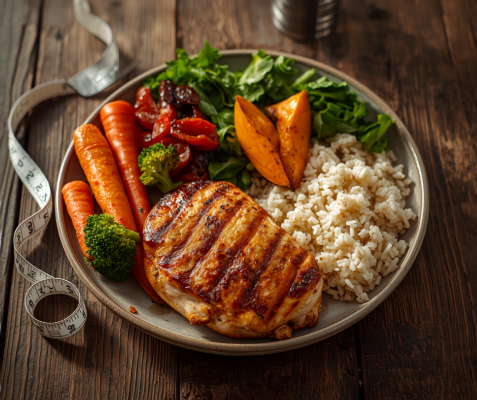
Is 1200 Calories a Day Enough to Lose Weight?
But for some reason, one idea refuses to die: that 1200 calories a day is the number for fat loss.
For most people, it's not just wrong — it can be dangerous. Let me explain.
Can I scare you into eating more calories today?
I know how hard it is to figure this stuff out. Between Google and social media alone, you're going to find conflicting views on pretty much every nutrition topic there is. But for some reason, one idea refuses to die: that 1200 calories a day is the number for fat loss.
For most people, it's not just wrong — it can be dangerous. Let me explain.
Where Did the 1200-Calorie Number Come From?
The 1200-calorie figure has been floating around diet culture for decades — it shows up in old magazine meal plans, generic diet programs, and even some calorie-tracking apps that default to it. It stuck because it's a nice round number that produces fast results on the scale.
But here's the problem: it was never based on your body. It's a one-size-fits-all number in a world where nobody is one size.
Your Calorie Needs Are Personal
Every single person reading this has different requirements to make progress, and lots of factors affect those requirements. One of the biggest — and the simplest to explain — is your current bodyweight.
The more you weigh, the more calories your body needs just to run your day-to-day life. Someone who weighs 120 pounds needs far fewer calories than someone who weighs 250 pounds. The 250-pound person may need double.
You'd have to live in a lab to know your exact numbers, but here are the general rules of thumb I use with clients:
10–12x your current bodyweight in calories per day for fat loss
12–14x your bodyweight for maintenance
14x and up for weight gain
This is a starting point. From there you adjust based on your activity level and your actual progress.
So if you weigh 120 pounds, 1200 calories might genuinely be in your range — and yes, it's hard being a naturally smaller person, because your requirements are just lower. But if you weigh 250 pounds, you're likely looking at 2500+ calories per day for fat loss. Eating 1200 would mean cutting your intake roughly in half of what your body needs — and your body will fight back.
What Happens When You Eat Too Few Calories
If you ate 500 calories today, nothing terrible would happen other than feeling hungry. The real damage comes from eating too little for an extended period of time. Here's what starts to happen:
1. Nutrient shortfalls. It becomes nearly impossible to get adequate vitamins, minerals, and macronutrients (protein, fats, carbs) on very low calories. Over time that can lead to a whole host of health problems.
2. Muscle loss. Without enough energy coming in, your body turns to your muscle for fuel and breaks it down. Since muscle is exactly what keeps you strong, mobile, and burning calories, this is the opposite of what you want.
3. Fatigue and weakness. You'll feel tired and drained — not just in your workouts, but in your whole life and your ability to get through daily tasks.
4. A weaker immune system. Chronic under-eating makes you more prone to getting sick.
5. A slower metabolism. Your body is incredibly good at adapting to its environment. If you chronically eat very low calories, it adjusts to run on less fuel — which is why the scale often stalls even though you're eating almost nothing.
6. Weaker bones. Long-term under-eating negatively impacts bone health, raising your risk of fractures and osteoporosis down the road.
The full list is longer, but that's as far as I feel qualified to go. If you recognize any of these in yourself, please chat with a professional — a dietitian or your doctor. If you need a referral, reply anytime and I'll point you to great people.
What To Do Instead
Forget the magic number. Aim for a moderate deficit based on your bodyweight, keep your protein up, eat plenty of fruits and veggies, and strength train so the weight you lose is fat — not muscle.
That last part matters more than most people realize. It's a big reason our boot camps and women's-only strength classes across Halifax, Bedford, Dartmouth, and Truro are built around progressive strength training — because losing fat while keeping (or building) muscle is what actually changes how you look, feel, and move.
Sustainable beats fast. Every single time.
Ready to Do It the Right Way?
If you want a plan that fuels your body properly and gets you strong instead of just smaller, come try us out. You can get 6 weeks at Evolve Fitness for just $1 — coaching, classes, and a community that has your back.
Start your 6-week $1 trial here.
Have a great day.
Matt
Are Cheat Days Good for Weight Loss?
I got a great question from a client recently: "How do I know when to have a cheat day, and how do I recover from it?"
Here's the good news. The whole idea of cheat days — and feeling like you need to "cheat" on your diet at all — has largely gone out the window.
I got a great question from a client recently: "How do I know when to have a cheat day, and how do I recover from it?"
Here's the good news. The whole idea of cheat days — and feeling like you need to "cheat" on your diet at all — has largely gone out the window. Ten-plus years ago it was all the rage, and like every fad, it came and went.
I used to do cheat days myself, until I learned how badly they were sabotaging my goals. These days, I enjoy my favourite higher-calorie foods in moderation, no matter what day of the week it is. Let me explain why that shift changed everything.
Where the Cheat Day Idea Came From
The old mindset went like this: deprive yourself of "treats" all week, then once a week (or two), eat all of your favourite foods in a single glorious day. That was your cheat day. Some people even promoted it as good for your metabolism — without any real evidence behind the claim.
The number one thing to remember is this: to reach your fat loss goals, you need to be in a calorie deficit. But that deficit is not a day-to-day thing. It's an average over time. Your body doesn't reset at midnight. It responds to what you do across weeks and months.
And that's exactly where cheat days fall apart.
What Cheat Days Were Actually Doing to Me
Two things kept happening when I did cheat days, and I see the same pattern in clients all the time.
First, my cheat days were really bad. If I'd bumped into a client at the grocery store on a Saturday morning, I would have been embarrassed by my cart. And the day was so high-calorie that it wiped out my entire week's deficit. One day of "cheating" undid six days of effort — my weekly average put me right back at maintenance, or worse.
Second, I felt like trash. My cheat day was always Saturday, so Saturday night, all of Sunday, and sometimes even Monday, I was zapped of energy and motivation. I was starting every week from behind.
Between the math and the misery, I was never really getting ahead. Sound familiar?
The Other Problems Nobody Talks About
Beyond my own experience, the cheat day mindset can bring some baggage that works against you long term:
An unhealthy relationship with food, where foods get labelled "good" and "bad." An emotional dependence on that one day of the week. A real risk of overeating that slides toward binge-style eating. And a plan that simply isn't sustainable — because white-knuckling deprivation for six days so you can "earn" the seventh is exhausting.
All food is energy, and you need energy to live. Some foods just carry more calories and fewer nutrients than others. That's it. There's no cheating involved in being a human who likes dessert.
What I Do Instead
When I finally understood that fat loss comes down to my average calories over time, everything changed for the better.
Now, if I want dessert, I have dessert. If I want a meal that's cheese whiz sandwiches (no judgment, please), I do that. No guilt, no "starting over Monday."
If I know a high-calorie stretch is coming — say, Thanksgiving weekend — I'll spend a few days beforehand eating a little lighter, with extra protein, fruits, and veggies. If it's an oopsie instead of a plan, I just do the same thing afterward. Either way, my average over time keeps me in a deficit, and I never feel deprived enough to "need" a blowout day.
That's the whole system. Enjoy the foods you love in moderation, keep the big picture in a deficit, and stay consistent — because consistency you can live with will always beat intensity you can't.
Building a Plan That Actually Fits Your Life
The goal is a nutrition plan that gets you the results you want and keeps you happy. That takes some time and some trial and error, and it works a whole lot better alongside regular training. That's exactly what we help people build every day at our Evolve Fitness locations across Halifax, Bedford, Dartmouth, and Truro — whether that's boot camp, spin, women's-only strength, or our Fitness Forever classes for the 50+ crowd. We also offer free fat loss coaching, so you never have to figure out the nutrition side alone.
I hope this helps reframe cheat days for you — and I hope we can retire the phrase "cheating on your diet" for good.
Ready to Ditch the All-or-Nothing Cycle?
If you want a plan (and a community) that makes consistency the easy part, come try us out. You can get 6 weeks at Evolve Fitness for just $1 — every class, every location, all levels welcome.
Get on the waiting list for our next 6 week trial here
Have a great day.
Matt